CASE STUDY
Case Study: SmartAsset
Preventing Regulatory Violations and Ensuring
Fiduciary Compliance in AI-Driven Personal Finance Assistants
Ensuring AI Financial Assistants Operate Within Regulatory and Fiduciary Boundaries

SmartAsset, a leading financial technology platform, connects consumers with vetted financial advisors and provides personal finance tools. As part of its growth, SmartAsset deployed AI-powered chat assistants to help users navigate complex financial topics, retirement planning, and advisor matching.
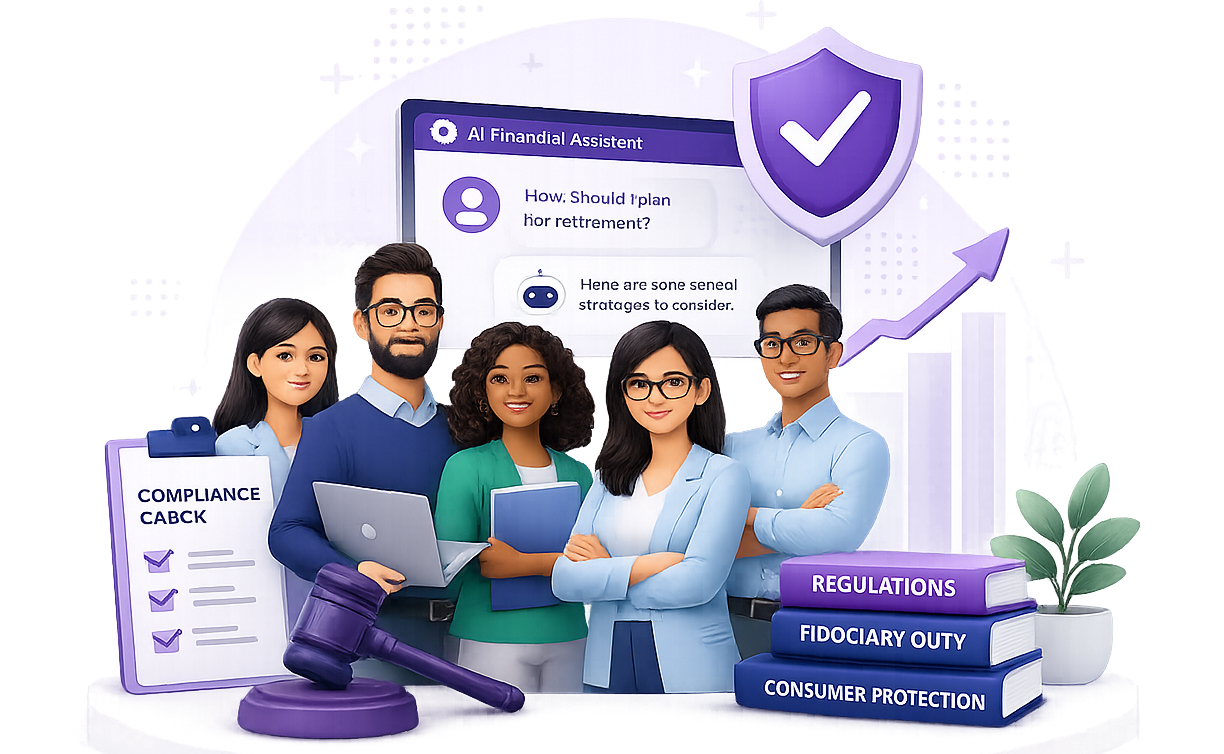
While AI enhances user engagement and scales financial education, it introduces significant regulatory exposure: AI agents interacting with consumers must comply with financial conduct rules and avoid providing explicit, personalized investment advice that crosses into fiduciary territory. Violations can result in substantial regulatory penalties, individual consumer complaints, and reputational damage.
The Human-in-the-Loop AI Audit Service continuously reviews AI financial interactions to identify conversations where agent behavior may constitute unauthorized financial advice, misrepresentation of risk, or a violation of financial consumer protection frameworks.
AI Financial Assistants Can Cross Regulatory Lines Without Triggering Automated Alerts
AI agents deployed in personal finance routinely handle:
- Retirement planning queries and asset allocation discussions
- Tax implication inquiries and saving strategies
- Debt management and repayment strategies
- Advisor matching and qualification criteria
Even technically accurate AI responses can create serious regulatory risk. Examples include:
- AI implies guaranteed returns on a specific asset class
- AI fails to provide necessary risk disclosures when discussing investment vehicles
- AI provides specific tax or legal advice rather than general educational information
- AI misrepresents the qualifications or fiduciary status of matched advisors
Automated observability platforms can detect factual errors but typically cannot assess whether a conversation's cumulative tone, sequence of statements, or implied recommendations cross the line from education to regulated financial advice.
THE REVALABS AI AUDIT ADVANTAGE
Revalabs provides an independent, human-in-the-loop oversight layer designed to identify nuanced, contextual failures in enterprise AI deployments that automated observability platforms cannot detect. Our specialized audit teams combine deep domain expertise with AI risk frameworks to evaluate the implicit tone, sequence, and real-world safety of AI-driven interactions. By bridging the gap between technical validation and human nuance, Revalabs ensures that AI systems operate securely, comply with regulatory standards, and deliver reliable outcomes without compromising user trust or brand integrity.
IMPACT
Reduced Regulatory Risk and Stronger Financial Governance
Reduced
regulatory risk
Stronger
AI governance
Higher
compliance confidence
Organizations can achieve:
Earlier detection of regulatory violations and unauthorized advice
Reduction in consumer complaints and regulatory exposure
Stronger AI governance for financial education operations
Increased confidence in AI-assisted advisor matching and content delivery
Continuous improvement of the AI assistant's compliance posture
By introducing independent human oversight, organizations gain visibility into risks that traditional QA frameworks may fail to identify before a regulatory inquiry is filed.